
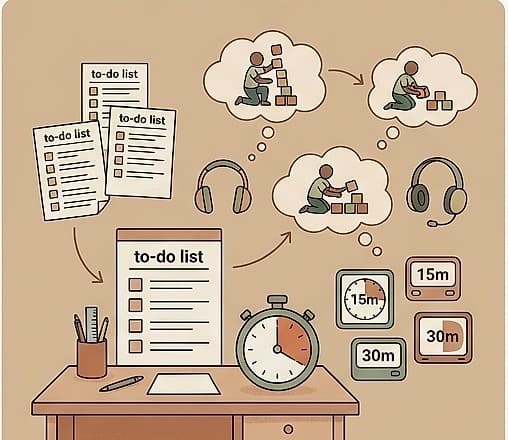
Therapy and, where prescribed, medication do real work, but a lot of what determines how manageable day-to-day life feels happens at home, in small structural choices rather than big interventions. None of what follows replaces professional support; it's what tends to make that support land better.
Externalize what you can. A child with ADHD isn't choosing to forget instructions, their working memory is doing something different from a neurotypical child's. Visual schedules on the wall, a checklist for the morning routine, and a timer they can see counting down rather than just being told "five more minutes" all move information out of memory and into the environment, where it's much easier to hold onto.
Break instructions into one step at a time, not because your child can't understand multi-step instructions in principle, but because holding several steps in mind while executing the first one is exactly the kind of task ADHD makes harder. "Put your shoes on" lands better as a whole request than as step three of "get ready for school."
Build in movement rather than fighting it. Fidgeting, needing to stand, or needing a movement break aren't defiance, they're often how a child with ADHD actually regulates enough to keep paying attention. A five-minute movement break before a homework session frequently produces a calmer, more focused fifteen minutes afterward than skipping straight to the work.
Praise the specific behaviour, immediately. "Good job" is vague and easy to tune out; "you stopped and thought before answering, that's exactly it" names the exact thing you want to see again, right when it happened. Delayed praise, even by an hour, is far less effective for a brain that's wired for immediate feedback.
Consistency matters more than any single technique. A routine that's "pretty good" and followed every day beats a "perfect" one that only survives a week. If something you try stops working, that's not failure, ADHD strategies frequently need adjusting as a child grows, and your therapist is the right person to recalibrate with.
This guide is general information, not a diagnosis or medical advice. If you're worried about your child, the next step is a conversation with a qualified therapist.
Keep reading
Ready to have someone look with you?
Book a verified therapist in Lagos, or take the 2-minute matching quiz to find the right fit.